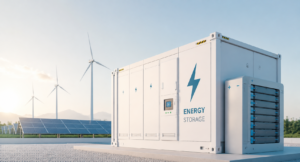
In practice, IA Law Firm Bosnia is increasingly advising investors, electricity producers and industrial consumers on projects involving Battery Energy Storage Systems (BESS). The reason is simple – in modern energy, the greatest value is often not in energy production, but in the ability to use energy at the right time.
A company that spends several million convertible marks annually on electricity may have a difference in energy cost of hundreds of thousands of marks just because of the moment it buys, uses or sells energy.
On the other hand, a solar power plant can produce the same amount of electricity as last year, and generate a significantly lower income because it produced energy during the period when the market price was the lowest.
In both cases, the problem is not energy production.
The problem is time.
That is, the question of how to use energy when it has the greatest economic value.
That is why Battery Energy Storage Systems (BESS) are becoming one of the most important investment topics in the energy sector.
Batteries aren’t just energy technology.
Batteries are often seen as technical equipment that accompanies solar power plants.
However, their real value is business.
Simply put, battery systems allow energy to be conserved when it is available or cheap, and used when it is needed or when it has a higher market value.
That is why batteries are now a tool for managing the price of energy.
Their economic value is most often reflected in:
- storage of surplus production from solar power plants and other renewable energy sources;
- the sale or use of energy during periods of higher prices;
- reduction of peak loads and network charges (peak shawing);
- reduction of balancing costs at electricity producers;
- backup power supply and increasing the energy security of the business.
And where is Bosnia and Herzegovina?
Although the regulatory framework for energy storage is still under development, the general direction is already visible.
Unlike solar and wind farms, the regulatory framework for electricity storage in Bosnia and Herzegovina is still evolving, with strong alignment with European Union energy legislation. Directive (EU) 2019/944 on common rules for the internal market for electricity is particularly important, recognizing energy storage as an important segment of the future energy system.
Investors today should pay attention to several key questions:
- whether energy storage is recognised as a specific energy activity;
- whether special permits or licenses will be required;
- the method of connecting the battery systems to the network;
- treatment of battery systems within the electricity market;
- the possibility of providing ancillary services to system operators;
- Regulatory treatment of hybrid projects that combine solar power plants and batteries.
The need to regulate electricity storage in recent years has been recognized by legislators at all levels of government in Bosnia and Herzegovina, which is evident from the following regulations:
| Level of regulation | Regulation | Energy Storage Status |
| Bosnia and Herzegovina | Connection Rulebook (“Official Gazette of BiH”, No. 64/2025) | In Article 2, it recognizes the possibility of energy storage and defines the term “stand-alone electricity storage facility”. |
| Federation of BiH | Law on Electricity of the Federation of BiH (Official Gazette of FBiH, No. 60/2023) | Article 6 regulates energy storage as an activity within the production of electricity, but also as an independent energy activity (storage operator). |
| Federation of BiH | Decision on the Conditions and Manner of Transformation of Existing Power Plants into Hybrid Electricity Storage Facilities (Official Gazette of FBiH, No. 33/26) and Rulebook on Licensing (Official Gazette of FBiH, No. 29/2024) | The Federation of BiH goes a step further and enables the development of hybrid plants, while the Rulebook provides for the issuance of a special permit for energy storage. |
| Republic of Srpska | Law on Electricity of the Republika Srpska (Official Gazette of the Republic of Srpska, No. 68/2020) | Article 5 recognizes the possibility of energy storage. In May 2026, a draft law was submitted to the procedure, which would regulate energy storage as a separate activity for which a separate permit is issued. |
| Brčko District of BiH | Law on Electricity of Brcko District of BiH (“Official Gazette of Brcko District of BiH”, no. 27/2021) | Article 6 provides for the possibility of storing electricity within the existing regulatory system. |
Although certain regulatory issues have not yet been fully resolved, especially in the part of bylaws and the precise definition of energy storage as a separate activity, the general direction of the development of regulations is clear – creating conditions for a wider integration of battery systems in the power sector.
Conclusion
Just a few years ago, investors wondered if investing in solar power plants was justified.
Today, the second question is increasingly being asked:
Can a renewable energy project reach its full potential in the long term without energy storage?
The question is no longer whether batteries will play an important role in the energy sector.
The question is in which sectors and business models they will create the greatest economic value the fastest.
For investors planning to develop solar power plants, BESS systems, hybrid energy projects or investments in the electricity market in Bosnia and Herzegovina, timely analysis of regulatory requirements, permits, licenses and contract models becomes as important as the technology itself.
More information on legal services in the field of energy, renewable energy sources, infrastructure projects, regulatory consulting, development of energy projects and investments is available on the website of IA Law Firm Bosnia: IA Law Firm Bosnia